Total Pageviews

Thursday, November 1, 2012

Gemstone Treatments 4

The piece pictured above is an 18k gold clasp with blue sheen moonstones hanging from blue sheen moonstone beads.  This is a new piece. I've been working on getting some new things out for the holidays and this is one of them.  I will soon have more pictures both on here and my website as we recently had another series of pictures taken by my photographer, Lorrie.  The moonstones in the clasp have had the background darkened to enhance the wonderful colors that come out in these stones.  Okay, back to gemstone treatments. 

Rubies are a form of corundum, which is the same material that sapphire is. The only difference is that it has to be red to be called a ruby.  There is a fine line sometimes between ruby and pink sapphire, but a lot of rubies, especially Burmese material, will have an element of pink in them.  Rubies are also one of the rarest forms of corundum, and as such, carry a much higher price tag then sapphires do, if the quality is equivalent (in other words there can be junky rubies much cheaper than fine sapphires).  Unfortunately because of this ruby treatments have become more of a problem than sapphire treatments in the trade.

Most major gem labs are now giving different treatment grades to ruby based on how aggressively rubies have been heated.  When rubies are heated, especially rubies with significant inclusions, flux from the heating process often enters the stone, and when the flux hardens it becomes glass.  This often means that there is glass inside the rubies. When rubies are aggressively heated--something being done particularly with very low quality material that is very heavily included, more flux gets into the cracks and forms glass.  A few years ago, the director of one of the leading gem labs at the time came out with a statement saying that it had become unclear in some of these aggressively treated rubies whether the proper description should be ruby with glass in it or glass with ruby in it as so much of the stones were made up of the flux material. 

The GIA currently uses a seven level grading system regarding heat treatment in rubies: NTE (no treatment) and then TE and TE1-5 with the increasing numbers indicating increases in flux residue.  Obviously when you hit TE5 you're in that zone where it's really pretty unclear what you are getting.  Personally I wouldn't sell anything higher than a TE3 as beyond this it's my belief that the level of treatment has been too aggressive.

There is also an argument running in the trade right now (I think I may be a lot of the cause of it) about disclosure on ruby treatments. The Jewelers Vigilance Committee (JVC), a group formed to act as an industry policeman, currently claims that in most ruby treatments, disclosure is not necessary. They base this on what I perceive to be a flawed argument, that there is simply so little unheated ruby material available that it isn't necessary as no one could purchase unheated material (this IS a valid argument in the case of something like tanzanite, a material that wouldn't even be sold were it not for heat treatment and in which 100% of the material is heated).  However I am able to source unheated ruby material and feel that this is a specious argument, mainly based on their collusion with larger manufacturers in the industry who don't want to deal with the disclosure issues.  The AGTA, another industry self policing organization, of which I am a member, does mandate disclosure of all ruby treatments.  When the new superheated ruby material came into the market, the JVC suddenly found itself in the position of having to reverse its prior statements about nondisclosure because the superheated material has durability issues and also is so beyond the norm that they were forced to issue changes in their disclosure requirements.

So what is a customer supposed to do?  Well, as I always tell people, know your sources.  If you are buying online, you will never really know who you are dealing with so I always recommend purchasing things like this from somewhere that you will have recourse if something isn't what is is supposed to be.  Secondly, if you see someone selling a 1-3 ct. ruby for under a few thousand dollars you can be pretty much assured that this is some of the aggressively treated material and you should stay away from it, not just because of the fact that you aren't really getting ruby but also because there are durability issues with it. While with smaller goods, there is no way around getting heated material (no one even bothers to check most of the time as it simply isn't worth it), if you are investing in a reasonable sized stone (1 ct. or above), ask for a stone with a certificate so you can at least know how heavy the treatment is.  If you really want a natural, unheated stone it is absolutely mandatory the stone comes with a gem lab certificate.  The material is out there, but you should be prepared to pay a price for it. A few years ago, a collector was in looking for a 2 ct. natural, unheated ruby and I got 6 stones in for him.  They ranged in price from $8000 to $120,000.  The $8000 stone was ugly as all get out.  Once you got up into the $30,000 range they got much better looking. 

Remember if it seems to be too good to be true it probably is. But this is a caveat that you should take into consideration when buying any product that you don't know that much about. In my next article I will get into a variety of other colored stones and their treatments.

Thursday, October 25, 2012

Custom Work and Gemstone Treatments 3

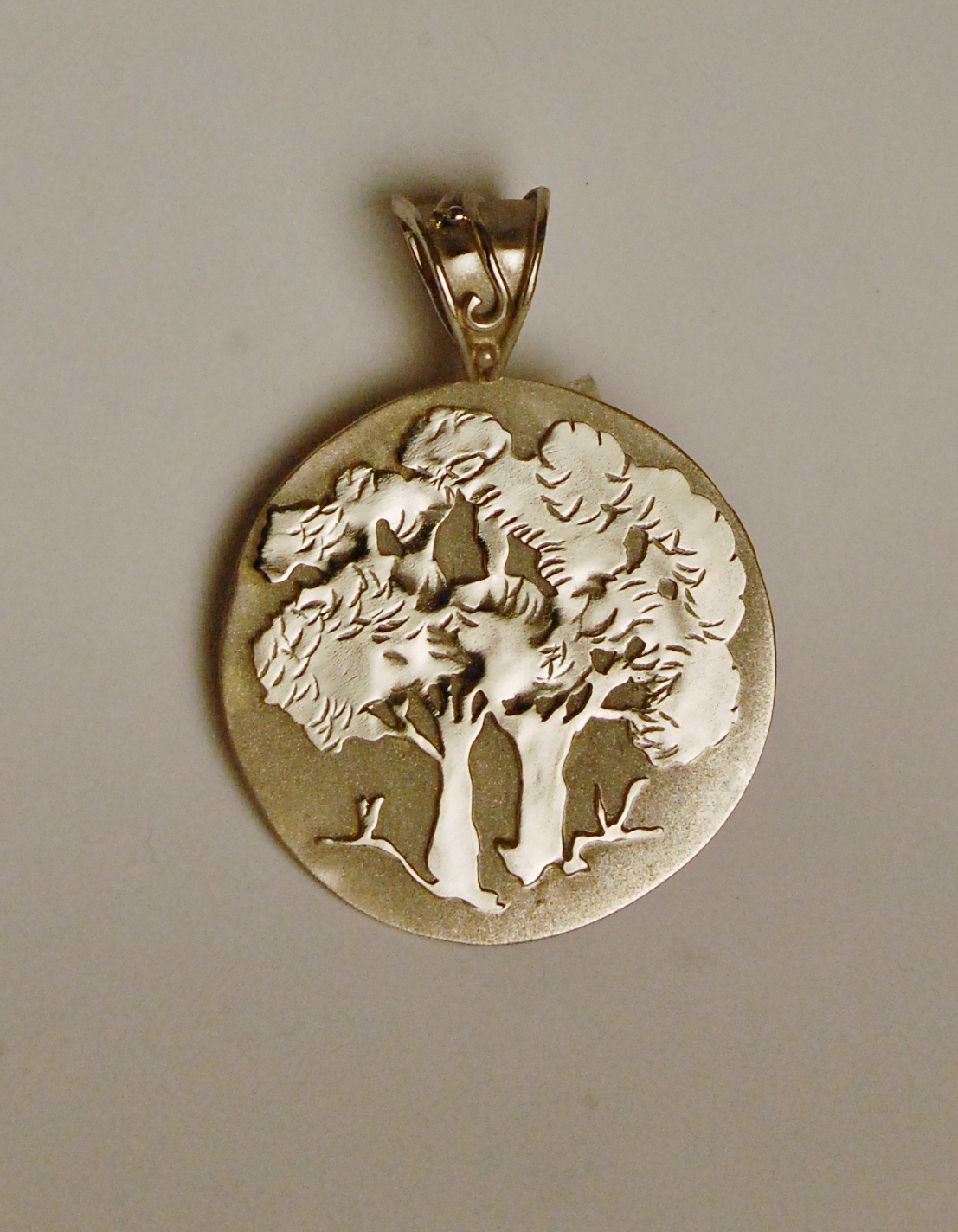
I always like doing custom pieces for people's anniversary presents because they always seem to carry more meaning than just someone having something custom made up for themselves.  I had a gentleman in recently who wanted a piece that was based on a design (picture above) that was used in their wedding announcements, so I made up the pendant shown above for him.  The design in this piece is all hand cut out and hand tooled.  If I had wanted to work with my CAD/CAM person I probably could have gotten a more accurate representation, but where is the fun in that?  It's just having a computer do all the work for you.  Plus it runs a bit more money usually.  This piece was made up in 18k palladium white gold with a sandblasted background.

Okay back to the gemstone treatment issue. Today's topic is sapphires.  First of all sapphires come in a wide variety of customers.  I know that my customers are all aware of this because I have so many fancy color sapphires out, but if you've never been in my store and only been to traditional jewelry stores then you might not be aware of this fact.  All of the colors of sapphires can be treated in some form or another.

The most common form of sapphire treatment on the market today is heat treatment. This is a process where the stones are put into ovens with controlled environments and baked for a period of time determined by the material being used and the desired results. Heat treatment is a process that changes the color of the sapphires, usually to a more "desirable" color (in blue sapphires this routinely means a darker color since that seems to be the most popular). This is a permanent color change and the stones never revert or change in color no matter what is done to them (recutting will not change the color).  The industry likes to say that we're doing what would have happened anyway to the stones if they had stayed in the earth a lot longer (oh say a couple hundred thousand years), which is sugar coating it a little but, as I stated in my first article on the subject, man has been trying to improve everything around him ever since the beginning of civilization.

There are now some companies that only sell untreated sapphires and I sell both heated and unheated stones.  With smaller goods it can be quite hard to know what you are getting because it simply isn't worth the time for anyone to check whether they've been heated, so normally I tell everyone that if the stone isn't certed natural, you have to assume it's been heated (which applies to virtually everything under 1 ct., as again, it's simply not worth it to check material in this price range). Occasionally, however, this isn't the case. I currently have a bunch of small orange sapphires that we know are natural because my dealers actually know the mine owner and this is his particular thing (not treating the gems that come out of his mine).

The more problematic sapphire treatment on the market today is called diffusion treatment. Diffusion treatment is a process in which they both heat the stone and diffuse a new element into the gems.  The problems with this is twofold. With some diffusion treatment, the treatment is only on the surface so if you were to damage the stone and have it recut it would be a different color. Not long ago, however, it was also found that some diffusion treatments (specifically in orange and orange/pink sapphires) were actually going all the way through the stone. The second problem with diffusion treatment, in my opinion, is that you are actually adding something to the stone that isn't found in it in its natural state. Because of these factors I do not sell diffusion treated gemstones.

The good news is that diffusion treatment in sapphires can be detected by gem labs (at the moment---the illegitimate treaters keep trying new things so it's always a battle to keep up with everything).  Most heat treatments are also detectable although the labs tend to err on the side of declaring stones heated even if there are only some minor hints at it (one of my dealers has had stones he knows to be natural come back with certs claiming heat treatment because the polishing process can create so much heat sometimes that it then appears that the stone has been heated).

These are the primary treatments for sapphires, although I once had a dealer try to sell me dyed material and I'm sure people are working on new ones currently.  I know that I said I would talk about rubies in this article too, but I think I'll leave that for my next article as there are some real problems these days with ruby treatments.

Tuesday, October 16, 2012

Gemstone Treatments 2

By now I hope you're all looking at your stones and wondering what the heck do I actually have in my jewelry.  As well you should, because gemstone treatment disclosure is a touchy issue for most jewelers.  Either because they don't think they can sell a stone they reveal to be treated, or because they simply don't know if the stone they are selling is treated, or because they don't even know about gemstone treatments at all (unfortunately this is far more common in the industry then you can imagine), many jewelers simply don't talk about the issue. This isn't to say none of them do but I believe treatment disclosure probably still runs well below the 50% rate based on the number of people who come in my store already wearing treated stones who have no idea about treatments. So the next question is what treatments are acceptable. 

In my shop I will sell stones that have been heated, irradiated, occasionally bleached (pearls), and with emeralds stones that have been oiled or fracture filled.  I will not sell diffusion treated stones, dyed stones, rubies heavily heated (more on this later) or any other types of treatments. Why do I draw this line? Heated, irradiated, and bleached gem materials will not ever revert or change in color.  All of the other treatments are not permanent, or if a stone was damaged and had to be recut would not have the same color, or take the treatment level to a point that makes the stone something it could truly never be. With emeralds there is so little untreated material available that it is simply impossible to purchase anything that hasn't been.  Oils, and some fracture fillers, do leach out over time and can change the appearance of the stone so extra care is necessary with emeralds.  This doesn't mean that stones that have been treated in other fashions shouldn't be sold anywhere. It just means that I won't sell something that is subject to change like that and that the stones should be priced accordingly.

So let's talk about individual gemstones and their treatments and we might as well start at the top of the pile with diamonds.  Diamonds have been subjected to treatments far longer than many people realize.  It started with attempts to change their color through irradiation. Unfortunately when they first started this they had no real idea what they were doing or dealing with and a number of diamonds were produced that became radioactive and stayed that way, leading to a number of finger disfigurements, back in the early days of our playing around with radioactivity. Watch dials were also a problem for people when they used radioactive materials to make them light up. Needless to say these issues put a quick end to that specific type of treatment.  However it was discovered later on how to irradiate stones without any residual radioactivity and diamonds have been irradiated to change their colors for quite a few years. 

The next treatment that came up with diamonds was laser drilling.  In playing around with lasers and diamonds it was discovered that a pinpoint sized hole could be drilled into the stone to dark inclusions inside the stone and then that a bleaching agent could be introduced to whiten the dark inclusions.  When I got my graduate gemologist degree in 1984 this had already been going on for quite a few years.  

Since then we have added fracture fillings (a substance is forced into inclusions in the diamonds to make the inclusions less apparent), and high pressure/high temperature treatments to raise the color grade of certain diamonds.  The interesting thing about this is that only certain types of diamonds (there are a number of different types of diamonds but this issue gets far too technical to discuss here) actually will take this treatment so there are a limited number of stones that could be subjected to it.

Please remember that all of the stones I am talking about here are natural gem materials that come out of the earth.  In my last posting on the subject I will get into synthetics and simulants.  In my next article I'll talk about sapphire and ruby treatments. 

The rings pictured above are my latest stacking set with pink, purple and blue sapphires.

Tuesday, October 9, 2012

Gemstone Treatments

I'm going to revisit this topic as it routinely comes up in my daily conversations and it's important for people to know what they are actually getting when they buy a gemstone in today's marketplace. Let me start however with a little story from my shop.

About 10 years ago we had a customer come into our store who had purchased a ring she liked elsewhere but the jeweler couldn't get her any sapphires that she liked so she had him put in a CZ (cubic zirconia--a synthetic gemstone) until she could find something else.  The stone was a decent sized stone (about 2 ct.) so what she was asking for wasn't impossible to find.  What she wanted was a natural color, unheated sapphire, and preferably with a certificate only from certain gem labs that she had decided were more reliable (I'm not sure why).  So we went out and got her some stones to look at.  She didn't like them.  So we got her some more.  She didn't like those either. After about 5 attempts and using a number of different suppliers we looked at her and said, we've kind of run out of sources and aren't really sure we're going to be able to find something you like that is within your needs.  About 5 years later she came back into the shop and asked if we would try again to find a stone.  So I said to her, okay I will but I really pretty much only work with one company these days for this kind of material and I'm only going to ask them to send one batch of stones to look at (it gets expensive shipping these things back and forth).  She said fine so I arranged with my suppliers to send a batch of stones.

They sent me nine stones, all of them around 2 cts. and all of them beautiful.  All nine of them were certed and of the nine, seven were certed natural and two were certed heated. She came in repeatedly with her husband and a number of friends. She finally picked out a stone.  Which one?  One of the heated ones.  Why? BECAUSE IT WAS THE COLOR SHE WANTED!

And that kind of explains why most gems are treated today.  Because it gives you the most desirable color.  This is not to say that you can't find natural, untreated gemstones in pleasing colors, or even in the colors achieved through heating.  You can, but it's a lot harder given what is going on in the gem marketplace.

So what is gemstone treatment?  It can actually be any number of things including, but not limited to, heating, bleaching, irradiation, oiling, fracture filling, lasering, dyeing, high temperature/high pressure treatments, resin enhancements, diffusion treatments, and probably a few more things that haven't been discovered yet.  Trying to alter the natural is nothing new.  Man, as you know, likes to alter things found in our environment and has been doing it for thousands of years. The ancient Egyptians used to throw agates into hot oil baths to "quench crackle" the stones and that was 4000 years ago! Emeralds have been oiled for hundreds of years to hide their inclusions.  Stones have had foil backs placed behind them for hundreds of years to alter their color in a piece.  People have attempted to dye most material ever since they realized that certain stones would take the dyes.

Is gemstone treatment wrong?  Well as long as it's being disclosed properly absolutely not.  There are some stones we basically wouldn't have if it weren't for treatments, with tanzanite being the most notable.  Tanzanite is a wonderful blue/purple color and 100% of it is heat treated. If it isn't treated it's just an ugly brown.  There are others that most people simply would have no opportunity to own if not for treatments with sapphire high on this list.  There is a vast amount of sapphire material that comes out of the earth too light to be that attractive or that has virtually no color at all. Without heat treatments so few stones would be available in attractive colors that no one but the wealthy could afford to own them.  From a personal standpoint I have no problem with certain treatments, heating being among them.  My wife owns both heated and natural color sapphires.  I wear a ring with a pink sapphire (heated), a purple sapphire (natural) and a diamond (natural--and yes there are diamond treatments). 

However there is the little issue of disclosure that comes up.  As a member of a number of ethics based organizations, and simply because I have always believed in it, I disclose ALL treatments in gem materials that I sell.  The Federal Trade Commission says only that treatments have to be disclosed if it makes a significant difference in price (they refuse to define significant) and that there is enough of both natural and treated material available (in other words, tanzanite wouldn't have to be disclosed as treated because there is no natural tanzanite).  Personally though I don't agree with them. I believe ALL treatments need to be disclosed as the customer should always know exactly what they are purchasing.

This is a lengthy subject so I will continue it in my next blog. The ring pictured above is 18k gold with a heated blue sapphire.

Wednesday, October 3, 2012

30 Years!

As of October 1 I have had a store open on the same block in Cambridge for 30 years.  That's 30 years of selling my handmade jewelry, 30 years of making custom wedding bands and engagement rings, 30 years of providing people the opportunity to note all of the special occasions in their lives.

So much has changed in that time period and yet so much is still the same.  When I opened (with a partner, under the name Spirer Somes Jewelers) in October 1982,  gold was selling for approximately $375/oz.
The Internet didn't exist yet and most small businesses didn't have any type of computer.  There were no cell phones.  There were no Starbucks on every corner. In 2004, the partnership broke up and I reopened under my own name. Today gold is selling for $1770/oz., all of my advertising is done on the Internet, computers are an absolute necessity, we use cell phones not just for talking, but texting, shopping, web surfing, reading, watching movies, and I'm sure someone must have proposed to someone else via the cell phone at some time. And then there is Starbucks.....

But in 1982 people did buy engagement rings, wedding bands, anniversary and birthday presents, just the same as they do today.  And I got just as much of a kick out of playing a role in so many important events for my customers as I do today.  Because, honestly, that's what has always brought me the greatest joy.  Yes it's nice that I can earn a living doing something creative, challenging and fun.  But that's not what really moves me.  What does move me is that I work every day of my life with individuals, who are going to purchase something that I actually designed and made, that they are going to wear and use every single day of their lives.  Not a day goes by that I won't, in some small way, be a part of such meaningful times of my customer's lives. How can you not love that feeling?

The woman who placed the very first custom order I ever took in is still a customer to this day.  And I have made her daughter's wedding bands.  I have always had dogs in my shop and customers still come in wanting to know where the (now long dead) dog is that they remember.  I have had customers who have come in and bought second and even third wedding bands from me (yes for different marriages) because they have liked what I do so much.  That's a kind of weird compliment, but hey, I'm located in Cambridge and anything goes here.

In those 30 years I have set in jewelry: human teeth, dog teeth, a piece of the Berlin wall, rocks from the top of Mt. Everest (I think the top is a little lower now on account of it), pieces of titanium removed after operations, tyrannosaurus rex teeth, beach rocks, shells, and just about every imaginable gem and mineral.  I can't say that I have ever been bored.   Every new challenge, whether in how business runs, or in the jewelry that I make, is always interesting to me.

I actually don't like dwelling on the past very much.  However, it is worth noting a large milestone in some fashion or another. So here I am writing a blog article (blogs???---the term didn't even exist 30 years ago) about this milestone for me. But I am truly looking forward to the next 25 years of helping my customers and continuing to be that small, meaningful, part of their lives.

Pictured above is a hand built, one of a kind, 18k gold wedding band.