Total Pageviews

Tuesday, September 14, 2010

More on Custom Work


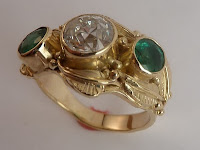
Custom work is always an interesting process. People come to me with all sorts of things, ideas, visions that they've had and then hope I can make them come to life. The picture here is what a customer brought in to me not long ago. She had a rather traditional looking three stone ring with a diamond and two emeralds but she wanted to do something else with the stones. So she drew up her idea on an envelope and brought it in. She said that she would allow me to exercise some of my own judgement when it came to the types of leaves and the overall look but that the drawing was pretty much what she had imagined. This project took me a bit longer than most as it required some thought behind how to get the stones at an angle, still make it wearable, and have some of the details she envisioned. Fortunately there was no time frame on it since she was just doing it for herself. These pictures are what I came up with:
I always recommend, when working with a jeweler on a custom design, that you like the kind of work they do in general. If you're giving an Art Nouveau styled design idea to a jeweler who only does geometric work you're probably working with the wrong person. On the other hand there are people like me out there who are adaptable enough to come up with pretty much any kind of design imaginable, which is not to say that I don't really prefer to work on pieces like this one that reflect a lot of what I do in general.

Wednesday, September 8, 2010

Alexandrite

Alexandrite, a member of the chrysoberyl family of gems is one of the most expensive gem materials on the market. Due to the way the stones absorb light, the color of these stones will change from a greenish blue color to a purplish red color depending on their light source (fluorescent/incandescent). As with all gem materials there is better and worse material out there so it is possible that lower grade material will not be so expensive but nice material always carries an incredibly steep price tag.

Alexandrite was originally found in Russia (hence the name as it was believed that the first piece was found on one of the birthdays of Czar Alexander) but sources in Sri Lanka and Brazil are now producing material as well.

In gemology, stones that do things like change color or have stars in them are known as stones with phenomenon. Personally I think alexandrites can simply be phenomenal stones. It is a stone however, that requires the purchaser to have an appreciation for the unusual, and is not neccessarily the most attractive of stones. While high quality alexandrite may achieve a rich purplish red color there is always a brownish tinge to this color and while people often wistfully say that the green approaches emerald green in tone, the color is less like emerald and more like tourmaline. In reality, even fairly expensive stones will have a muddiesh color tone to them and sometimes, under some lighting situations, the two colors will sort of blend together, again leaving a somewhat blurry image. But fine material can be truly astounding (and is exceedingly rare). One of the most beautiful stone I ever saw was at the Tucson gem shows about 25 years ago where one of the dealers had a magnificent 15 or 20 carat stone that had a huge color change and was beautifully transparent. I believe that the price was somewhat over $100,000 for the stone at the time (this was 25 years ago mind you!).

It seems that the people who know about, and love, this stone always tend to be collectors. I have one customer who owns 5 alexandrites that she has purchased from me. Another customer, who is mostly a gem collector, also has one he got from me. It is, however, an expensive habit. You can generally expect to pay between $5-10,000 per carat for decent one carat size stones. Larger stones are extremely rare so as soon as you get into the 2 ct. or bigger range the price range will skyrocket.

If you are interested in owning these stones here are the things to watch out for:

1) If the stone doesn't exhibit color change it isn't an alexandrite, it's just a chrysoberyl. There are many gem "dealers" on the Internet who sell stones they claim are alexandrite but they don't have any color change so they really can't be called that (I have seen a plethora of these stones show up in the last few years).

2) There are synthetic (man made) alexandrites that are in the market that are extremely hard to detect. You need to buy from a reputable source. If it sounds too good to be true it probably is. Interestingly, synthetic alexandrite is not a cheap stone to produce so the pricing on these will be higher than many other synthetics, which often means that they won't be so much cheaper than the natural that you would immediately be aware that it is a scam.

3) For many years, synthetic color change corundum (sapphire) has been on the market and was originally marketed as alexandrite because it had a color change. The colors are usually different from an alexandrite and after you've seen a few they are easy to identify. So if someone comes to you and says they own a really big alexandrite, most likely they are talking about synthetic corundum. I don't get as many people in with these as I used to, but over the years I have had to deliver the disappointing news to many people who said their mother/grandmother/great uncle/great grandfather swore to them that this was an alexandrite, that in fact what they had was a pretty much worthless bauble.

4) As with any expensive material there are always scams waiting to happen. Lately there have been a number of incidents in which jewelers have been approached by people (I actually had an email conversation with one myself) with large (ostensibly) alexandrites (among other stones) who will claim a variety of misleading things in an attempt to sell the pieces. They will say things like: oh, this stone is so valuable that no gem laboratory will identify it. Or that it is so valuable that they can't ship it to a gem lab to be identified. This is a load of hogwash. Any reputable gemological laboratory will identify any size gem material. As a matter of fact, they love to get in large, unique gem material because it increases their knowledge of what is available. And anything of any value can be shipped through a variety of means, and if they don't want to trust a shipper, surely if you have something worth so very much money, you can afford a trip to hand deliver the stone to a gem lab.

5) While it isn't absolutely necessary, it does help to have certificates from a reputable gemological laboratory on any major alexandrite purchase.

6) Know your source. Work with someone like myself who has both a Graduate Gemologist degree and has been in business for a long time. If they are a member of the American Gem Trade Association or Jewelers of America it helps as well. There are just far too many fly by night operations who are just out to make a quick buck and the Internet has expanded their numbers exponentially.

Thursday, August 26, 2010

Back in the Saddle Again


I had a very successful tax free day this year, in particular thanks to a few of my wonderful customers out there. But it's left me busier than ever. Besides trying to make up a bunch of new stock ahead of time for it (pictures will be forthcoming), I have been somewhat swamped with custom work as well. So I've been working 6-7 day weeks and nights. It does however get my creative juices flowing and I'm still putting out new stock. I just got in a triple strand of magnificent blue sheen moonstone beads that are going to the stringer this week (a picture will be forthcoming after the stringing) with a handmade clasp. I also just got in a South Sea black mobe pearl that I'm working on a pendant for. There is a large Asian gem and jewelry show about to take place and I've talked to a number of my suppliers about what it would be nice for them to pick up for me this year. This is just a brief check in but my next posting will be about alexandrite because Laurel asked about that and it is really a pretty interesting gemstone. I hope to get to that in the next few days.
The ring above is one of my wife's pieces and one of my favorites. It has a beautiful tourmaline in it.

Friday, August 6, 2010

Sales Tax Holiday and Too Much Work


Well as always seems to happen with my vacations I've been worker harder than ever since returning (hence my lack of posting of late). It's always a lot of work to get ready to go and then a lot of work to catch up. Unfortunately the vacations seem to fade way too fast because of this. It seems to be a big engagement ring time and I've had a slew of orders I've been working on so that all these couples can start a new life together. I do love to see couples in love! Actually it's the part of my business I like the most. Some of them are custom designs and as soon as I get them made up I'll get some pictures up.


The weekend of August 14-15 has been declared a tax free weekend in Massachusetts. It is a great time to buy those wedding bands or engagement rings that you know you're going to need anyway and to do a little early holiday shopping. My existing customers should watch their email folders for a special offer from us as well for the weekend (well only Saturday actually as we're closed Sundays). The tourmaline earrings above are currently available. They are hand built in 18k yellow gold with some beautiful dark green tourmalines.

Saturday, July 17, 2010

Back from Vacation and Metal Allergies


Well I'm back from vacation and somewhat rested. I think it was a good idea to take some time after my return from Martha's Vineyard off as well. It gave me a chance to ease back into things. As for the Vineyard we had some great (albeit hot) weather while we were there. It didn't rain at all. We had a wonderful stay at the bed and breakfast we stayed at: The Doctor's House and I would highly recommend it to anyone who wants to stay on the Vineyard. I think in the future I wouldn't stay quite as long. Neither Kathy nor myself are beach people so after about 4 days you run out of things to do there. But if you are into beaches there are plenty of pretty ones there. There were quite a few good restaurants we went to although it wasn't until near the end of the week that we found some decent bars as well. My idea of a decent bar may differ from most people's however as I look for my favorite drink, tequila, wherever I go. The picture is of me at the head of Aquinah on one end of the island. I think I look like I'm on vacation.

Now on to my topic of the day. I have been inundated lately (it seems) with people having allergic reactions to metals they are wearing. The reactions can range from mild irritation to serious scabbing. So let's discuss the causes of these problems.

The first thing is that many people confuse the problem they are having. People who wear wide bands often complain that they have a metal allergy but often it turns out that it is simply that things like soap, other cleaning agents, or dirt is collecting under the band (especially if there are bezel set stones on it in which case even more junk can collect in it) and it is this that is actually bothering people. If you seem to suddenly develop an allergy and you wear wide bands, I almost always recommend thorough cleanings (jewelers can do it better than you can but more on cleaning in a minute) first and then that you spend some time thinking about whether you have changed cleaning agents you are using, skin creams, perfumes etc. that may be impacting you because they are collecting under the band. If after doing this you are still having a problem then it may, in fact, be that you have a metal allergy.

Most people who have a metal allergy are in fact allergic to the alloys that are used when making gold into either 10k, 14k, 18k or 22k gold. The metal most people are actually allergic to is nickel. However, nickel is ONLY used in white gold. I routinely get people in who think nickel is used in yellow gold but it just isn't. As long as you are buying from reputable sources, nickel will never be used in making yellow golds. If you are having reactions to yellow gold then you are probably reacting to the copper or silver in the metal, BUT this is not always the case. Some people are allergic to gold as well. Platinum is the most hypo allergenic of metals on the market, but it is possible for someone to be allergic to platinum as well. Obviously if you are wearing base metals (costume jewelry) then the likelihood of being sensitive to it is very high.

Here is the other thing to remember: Our bodies change over time. You may not have been allergic to something when you were young but you may be as you get older. (Personally I never had allergies when I was young; now I can't make it through the spring without a lot of Claritin.) So if you have a reaction to wearing metal what do you do? Well if you are wearing white gold, I generally recommend that you stop and switch to platinum (although a good rhodium plating may help until the plating wears off) if you have to have a white metal. If you are wearing yellow gold, I generally encourage people to move up into higher karat golds. If you wear 10k (why anyone would want this metal I don't understand but that's just me I suppose) move up to 14k. If you wear 14k move up to 18k. If you're wearing 18k, and it is feasible for the design you want, move up to 22k (rings are not always durable enough in 22k gold). If none of these options work you may want to try platinum. For earrings there are hypoallergenic steel ear wires available if nothing else is working.

If none of these things help then you're just plain out of luck but it's worth trying them all first. If you are really enamored of white gold, some of us are now using a nickel free white gold which is colored with palladium (and zinc in some cases). Nickel in jewelry has actually been banned in a lot of the EU already and it would probably be a good thing if it was done here too, but don't count on it. Palladium white gold is more expensive than nickel white gold and that always means that manufacturers for the most part won't change their ways. I was actually somewhat instrumental in the reintroduction of palladium white gold into the US marketplace as a whole (due to my constant nagging of my gold supplier about how problematic the nickel white gold was to work with). I only sell 18k palladium white gold in my shop.

As for cleaning your jewelry at home here are my recommendations (because it always looks better and there is less of a risk of reaction to gunk collecting underneath rings). 1) Do NOT boil your jewelry. There is far too much of a risk of forgetting about it and returning to find your stones completely cooked after the water dries up. And yes, you can burn your diamonds. 2) I generally do NOT recommend home ultrasonic units. First of all they aren't as good as the commercial ones jewelers use. Secondly stones can break in them. 3) Do NOT use any of the commercially available jewelry cleaners that are profligate in the marketplace. I find they do more harm than good. 4) What you can do is take some ammonia (plain grocery store ammonia), Ivory Liquid (dish detergent) and warm water and mix it together. Any proportions will work, although obviously the more ammonia in the mixture the stronger it is. You can soak stuff in it for awhile and then use a soft toothbrush to scrub the stones, especially underneath them. This is where most of the dirt collects and it impacts the way a stone looks tremendously. Always scrub with plain water afterwards.

I would still encourage you to get your jewelry cleaned professionally at least twice a year. If you own a piece of jewelry from Daniel R. Spirer Jewelers I offer lifetime free cleaning on my work (and I'll do up to 6 pieces I didn't make for free too if you own something of mine----there are a few exceptions to this as some pieces can be major events and a charge will apply). Many other jewelers will clean jewelry for free as well, or have minimal charges (I charge $5 per piece---again with some exceptions---if the jewelry isn't mine). The advantage of bringing it to a jeweler however is that they can also check all the stone settings at the same time. You wouldn't ever drive your car for 2 0r 3 years without having a check up. Don't drive your jewelry for that long either without having a check up.