
 |
| 18k gold, tourmalines and diamonds |
Thursday, August 6, 2015
It's Tax Free Day Sale Time Again!


Tuesday, August 4, 2015
On Posting on My Blog
 | ||||||
| Boulder opal and green garnet earrings |
I had a discussion recently with a customer about her ability to post comments on my blog. For those of you who don't have a Google account, in the area where it says "Post As" click on the entry "name/URL". You don't have to put in a URL but you can just use your name. That assumes you want to leave your name. If not just do it anonymously.
I know I haven't written anything in awhile but please be watching for next week's announcement (which may actually happen later this week depending on how quickly our state legislators and governor can get their act together.
Wednesday, July 1, 2015
Pearls Before Swine (Put Your Pearls on Before You Eat Your Bacon)
 |
| Untreated Natural Color Akoya Pearls |
But first a few quick notes.
1) We will only be closed for the day of July 4. Usually I close for some time around the beginning of July but we will not be doing that this year.
2) Cambridge is working at eliminating parking spaces from the streets as quickly as it can so I again want to remind you that we do have a parking space available most of the time. But you have to call ahead and ask me if it's available and where it is. Please feel free to do so.
3) I routinely get customers in who swear to me that they read my blog all the time. But none of you seem to want to make a comment ever. This drives me nuts because I don't know if you're reading the blog if you never tell me on the blog itself. I have to wait until you come in the store and say "Oh, that last thing you wrote was really interesting". I read other blogs and all kinds of people make comments. What is up with that folks???? So anyone who posts a comment on this article can get a $25 credit against any case purchase in the future. I don't care what the comment says or is about. If you want to tell me my haircut looks stupid that's fine. I don't even care if you just want to tell me the latest joke you've heard. They are all good for that credit. It gets lonely here sometimes....
So pearls....Pearls have been around for a long time as a jewel. Well all gem materials have been around for a long time (they may just not have been found yet), but pearls have been known about and used as ornamentation for a lot longer than most (some believe they may be the oldest gem materials used). Originally pearls were natural, organic substances. They would grow in oysters (or freshwaters would grow in mussels in rivers) in the ocean. It is thought that some form of irritant would kick off the process of nacre forming around it and ultimately a pearl would form. Finding truly round pearls was extremely rare as the process is a natural process and couldn't be controlled in any way.
The pearling industry was huge for quite a few years. It was, in a typical human fashion, so large that the major pearling areas were fished out over a number of years. By the late 1800's most of the world's largest pearl beds had been overfished to the point of extinction. In 1919 oil was discovered in the Persian Gulf and the final remaining natural pearl beds of any size were ruined from the resulting pollution (as well as the over harvesting).
It was extraordinarily convenient then that at about this same time period a couple of Japanese entrepreneurs (Mikimoto was one of them) had worked out a way to grow a cultured pearl in an oyster. While experiments resulting in pearl like entities had been ongoing for a number of years, the Japanese managed to perfect the result. They discovered they could put a round bead nucleus (made of shell from American fresh water fisheries as it happens) into an akoya oyster and in a few years, a growth of nacre had formed around it creating a round (well sometimes) pearl. One of the keys to this development was figuring out how to get the bead nucleus into the oyster without killing it or stressing it out too much and then keeping them alive for the requisite growth period.
 |
| Untreated Cultured Blue Grey Akoya Pearls |
Originally, all of the cultured pearls available were grown in Japan. The Japanese waters were cool which slowed growth down somewhat. Additionally the type of oyster they could use was relatively small and pearls over the size of 9 mm were virtually unheard of. As long as the pearls were kept in the oysters for a long enough period, the nacre that was created in the somewhat cooler waters, usually produced a far better luster than seen elsewhere. Over time, some pearl farmers tried to speed up the growth process and wouldn't let the pearls remain in the oysters long enough which led to thinner nacre and lower luster, albeit cheaper, pearls.
In the 1970's and 1980's over development and pollution, along with a number of other economic factors (including China's entry into the cultured pearl market and the developing South Sea cultured pearl industry) reduced the number of Japanese pearl farmers drastically and the number of Japanese akoya pearls being sold. As it happens the Japanese took their knowledge and sold it to China as the industry there ramped up. While the Chinese produced akoya pearls, they were almost always lower quality (and produced in huge quantities which dragged the prices down of all the goods).
The Japanese also produced some of the best known freshwater pearls for a period of time. The term "Biwa" pearl came into existence because of how many freshwater pearls were produced in Lake Biwa in Japan. While natural freshwater pearls had been around in the past (New Jersey produced large numbers in the early 1800's and Tennessee was a large source), the same issues confronting natural salt water pearls, over fishing and industrialization and the resulting pollution, eliminated most of them. Freshwater pearls are produced by inserting a piece of mantle tissue into a mussel and allowing a growth to form around that. The resulting pearls were usually a free form shape, which for jewelers like me, were much more interesting. However Japan was faced with pollution in its lakes as well (which we believe led to some fascinating highly metallic looking pearls for awhile) and ultimately the freshwater pearl industry there pretty much stopped as well.
 |
| Bead Nucleated Freshwater "Edison" Pearls |
In the meanwhile, the Chinese were moving at a rapid speed in the freshwater pearl market as well. They produced so many low quality pearls that the prices on all of them plummeted as the market was flooded with a large amount of junk. So then they turned to trying to produce a true round pearl to replace the Japanese akoya pearl industry that had was pretty much disappearing. They were quite successful at this, but the resulting pearls have just never been as nice as the Japanese akoyas were. The luster was never the same and if you held a strand of the Chinese freshwater rounds next to the Japanese akoyas, you would immediately see the difference.
However, both Japanese and Americans have been working with the Chinese in the last couple of decades and new products are coming out all the time. The latest thing has been bead nucleated fresh water pearls in which round bead nuclei are inserted into the mussel and a pearl forms around it.
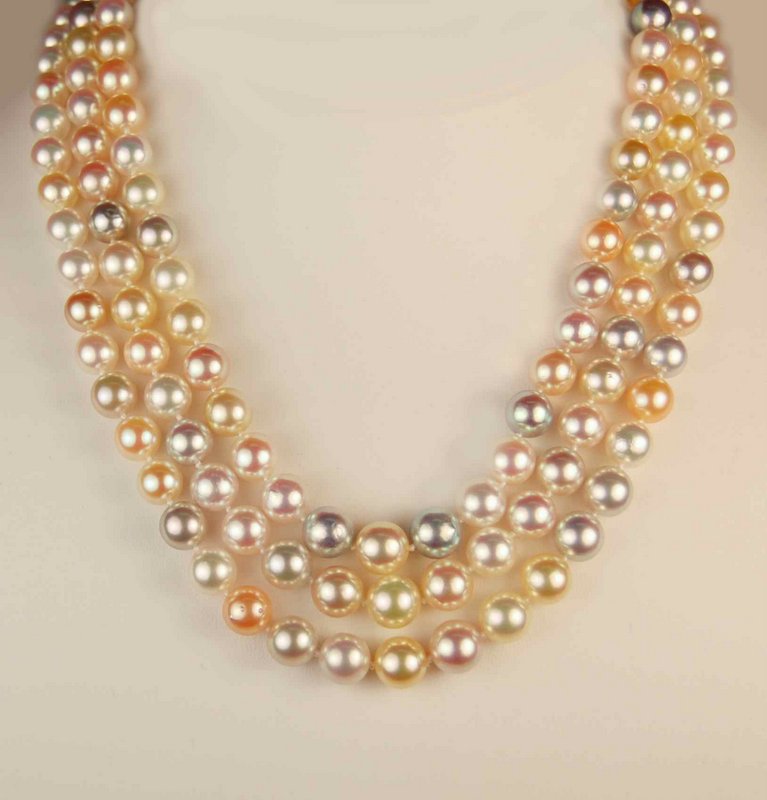 |
| 3 Strand of Untreated Akoya Cultured Pearls |
I'll be looking forward to your questions and comments!
Saturday, May 30, 2015
Suspenders
 |
| Tanzanite, 18k gold pendant with diamond accent |
A few years ago though my wife found out that we could send back the suspenders to the company and after a few weeks they would come back to us completely repaired and (almost) like new again. And there was absolutely no charge! The only thing we paid for was the shipping to the company (not the return shipping). What an amazing company! I mean what other company would offer a service like this???
Oh wait a minute, I do!!* Yes I actually fix my jewelry for free, including resizings, repointing of prongs, replacing worn bezels, and anything that just breaks. Can you say that you know of any other companies that do this?
I can't tell you how many times I get young, newly engaged customers in here who have engagement rings they bought elsewhere that don't fit and they tell me that the store they bought them from won't resize them for free or will only do it once. Is that truly the kind of store you want to buy your fine jewelry from ?
*(Disclaimer: I won't pay for return shipping---unless the error is mine---as the costs involved for shipping and insuring jewelry is more expensive than suspenders.)
The pendant pictured above is a new piece I just put out with a very, very cool tanzanite. It is cut in a buff top cut which means that the back of the stone is faceted but the top is cut smooth like a cabochon cut stone. It is a very blue tanzanite and it looks a lot like you're looking into a pool of water when you look into the stone.
My next posting is going to be about pearls because I recently saw one of my pearl suppliers who I don't get to see often and I got some amazing new strands in that I should have pictures of soon and that are quite unique.
Friday, May 8, 2015
Tequila and Diamonds, Cheese and Sapphires
 |
| Rainbow moonstones, garnets and 18k gold |
Don't get me wrong. If you want a big diamond, I'm happy to get it for you. I just sold a stunning 1.70 ct., "F" color, VVS1 clarity (almost flawless!) Lazare Diamond just the other day. But you
certainly don't need a large one to have an equally spectacular stone.
Now let's get on to the cheese. I was having some Comte that I had picked up at Whole Foods. Normally when I need a good cheese I head over to Formaggio's Kitchen, a small cheese shop (the only cheese store in America with a cheese cave underneath it!), and get what I want because they consistently have the best cheese in the area. And as it happens, I particularly like Comte, so I buy it often. However when I cut into the Comte from Whole Foods, it immediately became apparent that it was nowhere near the quality of what comes from Formaggio's. The piece of cheese broke in half (Comte is a fairly dense cheese and I had never had a piece do this before) immediately, the color was off and quite frankly the taste was completely bland and nothing at all like the ones I get from Formaggio's. I went back and looked at the wrapper and realized I was paying the same price per pound as I would have at Formaggio's!
So how does this relate to jewelry? First of all the fact that Formaggio's is a small operation allows them to more individually source their product. They often know their suppliers personally, they are fussy about what they will take, and they actually check each piece of their product when it comes in. This directly relates to the way that I purchase the colored stones that I buy. I know my suppliers personally (some I have known for almost 40 years), they know what the quality is I am looking for and won't even bother sending me stuff they know isn't up to my standards and I actually check each stone that comes into my hands personally. When you buy from a chain operation, or even from a jeweler who simply doesn't make their own work but just buys finished goods from their various suppliers, you will never get this kind of attention to detail. So you may be able to find sapphires that are larger and priced the same as my smaller ones, but you will not get the quality you can get from someone like me.
I'd continue my analogies into the actual meal we ate, but I'm starting to get hungry with all of this food talk and dinner is still quite far in the future. But by now, I'm sure you get the idea!
Subscribe to:
Posts (Atom)